Shape Constant RAM¶
shape_const_ram provides a single source of truth for the (X, Y, Z)
tensor-shape constants used by both the fmap and weight MEMSET
descriptors. It replaces the byte-for-byte duplicate pair
fmap_array_shape + weight_array_shape (Stage E analysis §6.3.1,
Stage C decisions memo item 5) and is wired into Memory Dispatch
as the new target of the MEMSET write path.
The migration consolidates the two legacy modules into one parameterised RAM. Migration validation and review are still in progress on the v002.0 release line — see the roadmap “Now” section for the broader phase context.
Geometry¶
The module is parameterised by Depth. With Depth = 64, the storage
footprint is exactly 64 × shape_xyz_t = 64 × 51 bits, matching the
combined footprint of the two legacy modules.
shape_xyz_t is a packed struct of three shape_dim_t fields ordered
{ Z, Y, X }. The typedefs are owned by isa_pkg and reused by the
dispatcher and the MEMSET decoder.
Interface¶
Direction |
Signal |
Width |
Meaning |
|---|---|---|---|
input |
|
1 |
Core clock @ 400 MHz |
input |
|
1 |
Active-low synchronous reset |
input |
|
1 |
Write enable for the current cycle |
input |
|
|
Write entry index |
input |
|
51 |
Packed |
input |
|
6 ( |
Read pointer (matches |
output |
|
51 |
Combinational read of the entry |
Latency:
write — 1 cycle (synchronous to
clk).read — 0 cycles (combinational). Consumers see the new value in the same cycle the read pointer changes.
Throughput: 1 write + 1 read per cycle.
Reset state: all entries cleared to '0 synchronously when rst_n is
asserted low.
Wiring into mem_dispatcher¶
The dispatch path described on Memory Dispatch previously routed
MEMSET payloads into the legacy fmap_array_shape / weight_array_shape
pair. After Phase 3 step 1 they are routed into a single
shape_const_ram instance, with the fmap-vs-weight selector folded into
the address decode. The port-width contract (3 × 17-bit fan-out) is
preserved, so the dispatcher migration is a one-line swap and a port
name change.
Spec reference: pccx v002 §3.3 (MEMSET) and §5.4 (shape pointer routing).
Data flow¶
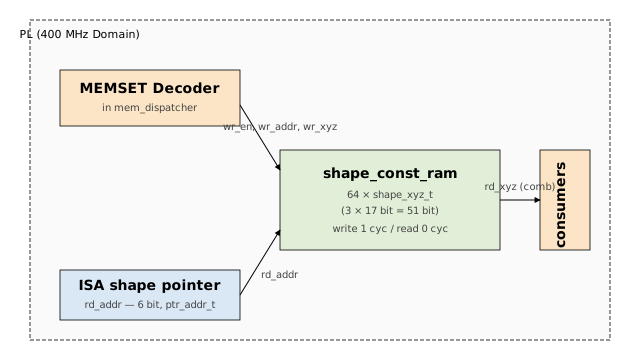
Figure 19 Write path: the dispatcher’s MEMSET decoder drives wr_en / wr_addr
/ wr_xyz synchronously. Read path: the 6-bit rd_addr from the ISA
shape-pointer field returns rd_xyz combinationally to the compute-path
consumers.¶
Source¶
module shape_const_ram
  import isa_pkg::*;
#(
    parameter int Depth = 64
) (
    input logic clk,
    input logic rst_n,

    // ===| write |===
    input logic                       wr_en,
    input logic [$clog2(Depth)-1:0]   wr_addr,
    input shape_xyz_t                 wr_xyz,    // packed { Z, Y, X }

    // ===| read |===
    input  ptr_addr_t                  rd_addr,  // 6-bit pointer (matches Depth=64)
    output shape_xyz_t                 rd_xyz    // packed { Z, Y, X }
);

  // 64 × 51-bit (3 × shape_dim_t) flop array. Vivado infers FFs because
  // the read path is combinational; consumers therefore see 0-cycle reads.
  shape_xyz_t mem [0:Depth-1];

  // ===| write (sync to clk) |===================================================
  always_ff @(posedge clk) begin
    if (!rst_n) begin
      for (int i = 0; i < Depth; i++) mem[i] <= '0;
    end else if (wr_en) begin
      mem[wr_addr] <= wr_xyz;
    end
  end

  // ===| read (comb logic - latency 0) |=========================================
  assign rd_xyz = mem[rd_addr];
Last verified against
Commit 18d4631 @ pccxai/pccx-FPGA-NPU-LLM-kv260 (2026-05-06).